
8 Design Mistakes That Make Small Closets Feel Even Smaller
Adam Bender | June 18, 2026
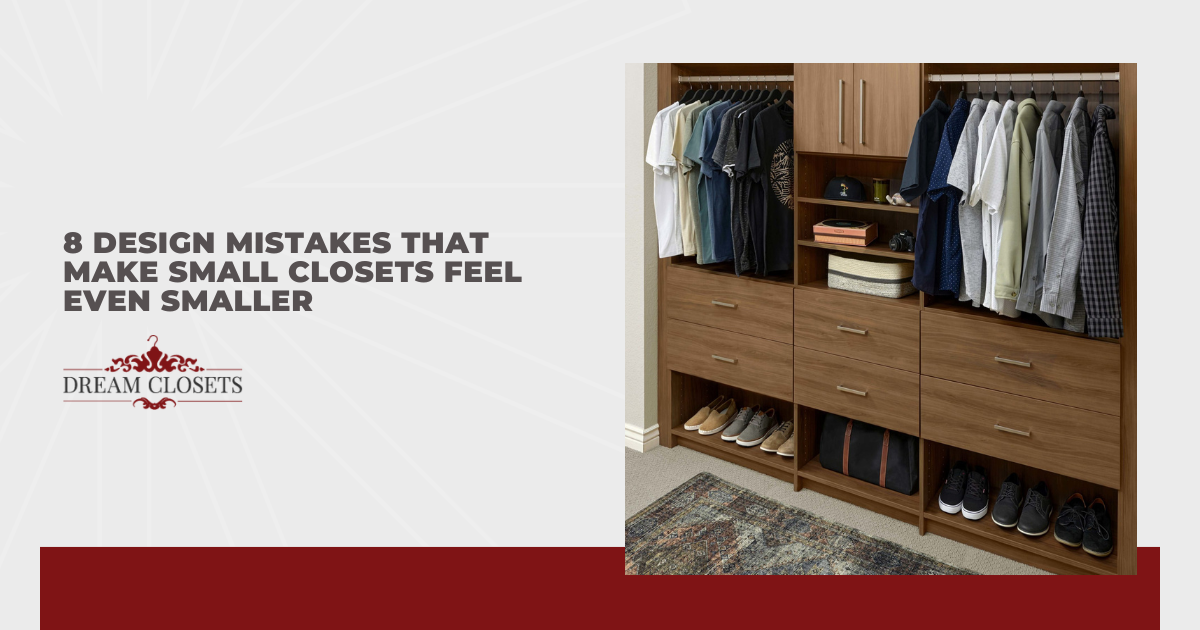
Small closets get blamed for a lot of problems they didn't actually cause. The truth is that most of them feel cramped and frustrating because of design choices, not square footage. You can have a roomy closet that still feels claustrophobic and a tiny one that works beautifully. The difference almost always comes down to a handful of avoidable mistakes.
Once you know what to look for, the fixes are surprisingly simple. Most of them cost very little and require no renovation at all. You're usually working with the space you already have and just learning to use it more wisely. A few small adjustments can completely change how open your closet feels.
These are the eight design mistakes that quietly make small closets feel smaller than they really are:
- Picking the wrong closet door
- Ignoring the back of the closet door
- Painting the interior a dark color
- Relying on a single hanging rod
- Forgetting to add proper lighting
- Using bulky and mismatched hangers
- Overstuffing the space with oversized bins
- Letting clothes pile on the floor
Walk through each one below and you'll probably spot a couple hiding in your own closet right now. Fixing even half of them makes a noticeable difference.
Picking the Wrong Closet Door
A swinging door is the default in most homes, and it's also one of the worst choices for a tight closet. The door needs a clear arc to open, which means a chunk of your bedroom floor has to stay permanently empty. You lose the wall behind the open door too, since you can't reach past it comfortably. In a small room, that wasted footprint adds up fast.
Track-mounted sliding doors solve part of the problem because they don't swing out at all. The tradeoff is that you can only ever see half the closet at once, so a wide reach-in can feel divided. Bifold doors fold back on themselves and give you a full view with very little clearance, which makes them a strong pick for narrow spaces.
I've walked into plenty of small closets where simply removing the door changed everything. An open closet framed with clean trim or a curtain reads as part of the room, and it feels larger because your eye isn't stopped by a slab of wood. Before you commit, measure your door's swing, since a swap is worth it if that arc eats into a walkway.
Ignoring the Back of the Closet Door
The inside face of your closet door is prime storage space, and in most homes, it sits completely bare. It's a flat vertical surface you already own, right at the point of use, doing absolutely nothing. Putting it to work pulls clutter off your shelves and rod, which is exactly what a cramped closet needs. The door becomes an extra wall of storage without taking a single inch of floor.
Over-the-door racks are the simplest option since they hook over the top and need no hardware. They hold shoes, accessories, cleaning supplies, or small folded items that would otherwise crowd a shelf. Slim wire baskets and adhesive organizers work well too, and they keep the profile thin enough that the door still closes flush. The key is staying shallow so nothing bumps the frame.
Hooks are the most flexible choice for belts, bags, scarves, or jewelry you want to see at a glance, turning a dead surface into a visible home so you stop digging through drawers. Before you load it up, confirm the door is solid enough to carry weight, since hollow-core doors have limits. Anchor heavier organizers into the frame or studs, and treat the back of the door as the bonus shelf it really is.
Painting the Interior a Dark Color
Color does a lot of quiet work in a small closet, and a dark interior works against you. Deep shades soak up whatever brightness reaches them, so the walls feel like they're pressing inward. The back of the closet sinks into shadow, and the whole space reads as a dim, shrinking box. Lighter colors do the opposite by bouncing brightness around and pushing the walls visually outward.
Crisp white is the safe default, and for good reason, since it reflects the most and makes even a cramped reach-in feel airy. Soft neutrals like pale gray, warm cream, or a barely-there blue give you the same opening effect with a little more warmth. I painted a narrow hallway closet a flat charcoal once because it looked sharp on the swatch, and the finished space felt half its actual size. Repainting it a soft white was the cheapest upgrade I've ever made to a closet.
Finish matters as much as the shade, since a satin or eggshell sheen reflects gently while flat paint absorbs more and looks dull. If a full repaint feels like too much, start with just the back wall and shelving, since a lighter back draws your eye deeper and makes the closet seem to extend further. Pale shelves blend into the walls instead of chopping the space into dark bands.
Relying on a Single Hanging Rod
One rod running the length of the closet is the standard setup, and it quietly wastes a huge amount of room. Short items like shirts, blouses, and folded trousers only need a few feet of vertical space to hang. Everything below them hangs empty, leaving a tall column of dead air that does nothing. In a small closet, that unused stretch is some of the most valuable space you have.
Double-hanging is the fix, and it can nearly double what the closet holds. You mount one rod high and a second rod below it, then fill both with shorter garments. Shirts go up top, pants or skirts go beneath, and suddenly the empty column is full. Adjustable systems let you set the rod heights to match your actual wardrobe rather than guessing.
Not everything suits a doubled rod, so keep one tall zone for full-length pieces like dresses and coats that need an uninterrupted drop. Double up everywhere else with a cheap tension or clip-on rod that installs in minutes without tools. Measure your longest items first so the lower rod sits where it won't drag on the floor.
Forgetting to Add Proper Lighting
A closet with no light source of its own is fighting a losing battle. When the only brightness comes from the bedroom behind you, your own body blocks it the moment you step in. The back of the closet falls into shadow, and you're left squinting at dark shapes. A space you can't see clearly always feels smaller and more cramped than it actually is.
Battery-powered LED puck lights are the easiest entry point because they stick on anywhere and need no wiring. Motion-sensor versions switch on the instant the door opens, so you never fumble for a switch with your arms full. Rechargeable strip lights tucked under a shelf give you an even wash of brightness across the whole space. None of these require an electrician or a single hole in the wall.
Where you place the light matters as much as adding one, so aim it toward the back wall to make the closet appear deeper and light the rod from above so clothes read as distinct items. A neutral white around 4000K shows colors accurately without the harsh blue cast of cooler bulbs. Avoid anything too yellow, which muddies darker garments and makes even a tiny closet feel dingy.
Using Bulky and Mismatched Hangers
Hangers are easy to overlook, yet they have an outsized effect on how crowded a closet looks. Thick plastic and chunky wooden hangers each eat up an inch or more of rod width, and that adds up across a full wardrobe. A mix of shapes and colors also creates visual noise, so even a tidy closet reads as chaotic. The eye can't settle, and the clutter feels worse than it is.
Slim velvet hangers are the standard upgrade for a reason. Their thin profile lets you fit noticeably more garments on the same rod, often a third more than bulky versions allow. The flocked surface keeps clothes from sliding off, so you skip the pile that collects on the floor. They're inexpensive enough to swap your whole closet over at once.
Matching matters almost as much as slimness, since a single style and color lines your clothes up at an even height and reads as one calm row. I resisted replacing my hangers for years as a pointless expense, but switching freed up enough rod that I stopped double-stacking shirts. A consistent set of slim hangers is the cheapest way to make a packed rod feel roomy.
Overstuffing the Space With Oversized Bins
Big storage bins feel like a smart move, but in a small closet, they often backfire. A deep, oversized container swallows shelf space and rarely fills efficiently, so you end up with wasted room inside the bin itself. The larger the box, the more tempting it is to toss things in without a system. What looks organized from the outside is usually a black hole you have to dig through.
Right-sizing the container to the shelf is what keeps the space working. Shallow bins that match your shelf depth let you see and reach everything without pulling the whole box down. Clear or labeled containers mean you spot what you need at a glance instead of guessing. Smaller, purpose-sized bins also stack and align cleanly, which keeps the shelf looking orderly.
Scale should follow what you actually store, so group small items in compact dividers and reserve larger bins for bulky things like spare bedding kept up high. A quick audit usually reveals one or two giant bins doing very little, and two slim ones often hold more in their place. The right-sized container makes a small closet feel deliberate instead of stuffed.
Letting Clothes Pile on the Floor
I'll admit the floor of my closet was a dumping ground for years, and I never connected it to how cramped the space felt. A pile of shoes, laundry, and bags spreading across the floor shrinks a closet in both ways that matter. It physically blocks the space you'd stand in, and it gives your eye a mess of clutter that makes the whole closet read as smaller. Clearing the floor was the single fastest way I made mine feel open again.
The floor is real storage, so the goal is to use it on purpose rather than let it fill by default. A low shelf or cubby unit along the bottom keeps shoes lined up and off the open floor. A slim dresser or a set of drawers tucks folded items away and uses the vertical space above the floor instead of just the ground. Even a single rolling bin corrals strays without sprawling.
Shoes are usually the biggest floor offender, so a tiered rack or stacked shelf gets them up and visible in neat rows instead of a heap. A clear band of open floor ties it together, since a visible stretch of bare floor signals room even when the closet is otherwise full. Give everything a designated spot, and a closet with its floor under control feels calm and noticeably bigger.
Conclusion
None of these fixes require knocking down a wall or spending a fortune, which is the encouraging part. Small closets have a way of convincing you they're hopeless, when really they're just asking you to use what you've got more thoughtfully. Pick off two or three of these mistakes this weekend, then watch the space open up around you. A closet that once felt like a cramped afterthought can end up being one of the most satisfying corners of your home.

QUICK LINKS
CONTACT INFO
Dream Closets LLC
404 E Wigwam Blvd,
Litchfield Park, AZ 85340
Phone
SCHEDULE A CONSULTATION
Contact us, and we will come out and discuss your project free of charge.